

Understanding TPE, TPR, SEBS & SBS
Exploring the molecular foundations of Thermoplastic Elastomers.
TPE is a broad family of materials including TPU, TPEE, and TPV. Our focus is the TPE-S system, based on SEBS or SBS.
I. Molecular Configuration
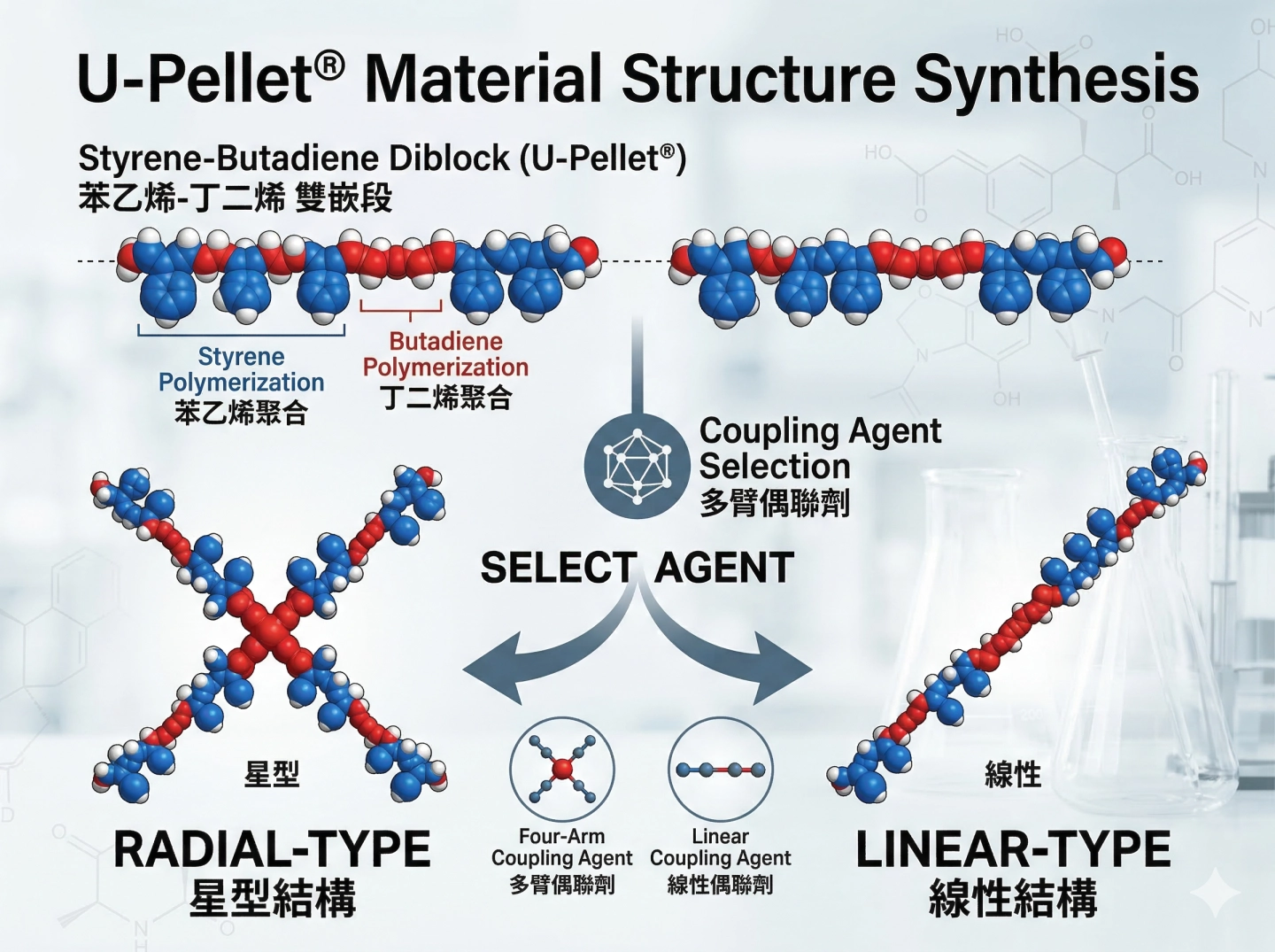
SBS molecular structure is determined by the terminator (coupling agent) during anionic polymerization.
Linear Structure
Formed via Bifunctional Terminators.
Radial (Star) Structure
Formed via Multifunctional Terminators.
The Hydrogenation Process
SEBS is the hydrogenated version of SBS. This process enhances stability without changing the structural configuration.
II. Performance Comparison
 Scroll left/right for more info
| Properties | Radial (Star) SEBS/SBS | Linear SEBS/SBS |
|---|---|---|
| Abrasion Resistance | ⭐⭐⭐⭐ | ⭐⭐⭐ |
| Resilience (Elasticity) | ⭐⭐⭐⭐ | ⭐⭐⭐ |
| Tear Strength | ⭐⭐⭐⭐ | ⭐⭐⭐ |
| Processing Flowability | ⭐⭐ (Poor) | ⭐⭐⭐⭐ (Excellent) |
| Tensile Strength | ⭐⭐ | ⭐⭐⭐ |
🔹 Radial (Star) Structure: Due to shorter molecular chain branches and a more "compact" structure, it offers superior elasticity and resilience. However, its lower melt flow index makes injection or extrusion molding more challenging.
🔹 Linear Structure: Featuring straight molecular alignment, it provides exceptional flowability and ease of processing, resulting in a smoother, glossier surface finish.
III. Application Strategy
Radial (Star) SEBS
Best for products requiring high resilience and low compression set over long periods.
- Construction Seals & Gaskets
- Fitness Resistance Tubes
- Maintenance-free Tires (e.g., Bike-sharing)
- Industrial O-rings & Washers
Linear SEBS
The stable choice for complex geometries and high-efficiency mass production.
- Footwear & Shoe Soles
- Toys & Daily Necessities
- Ergonomic Tool Grips
- Intricate Cross-section Profiles
